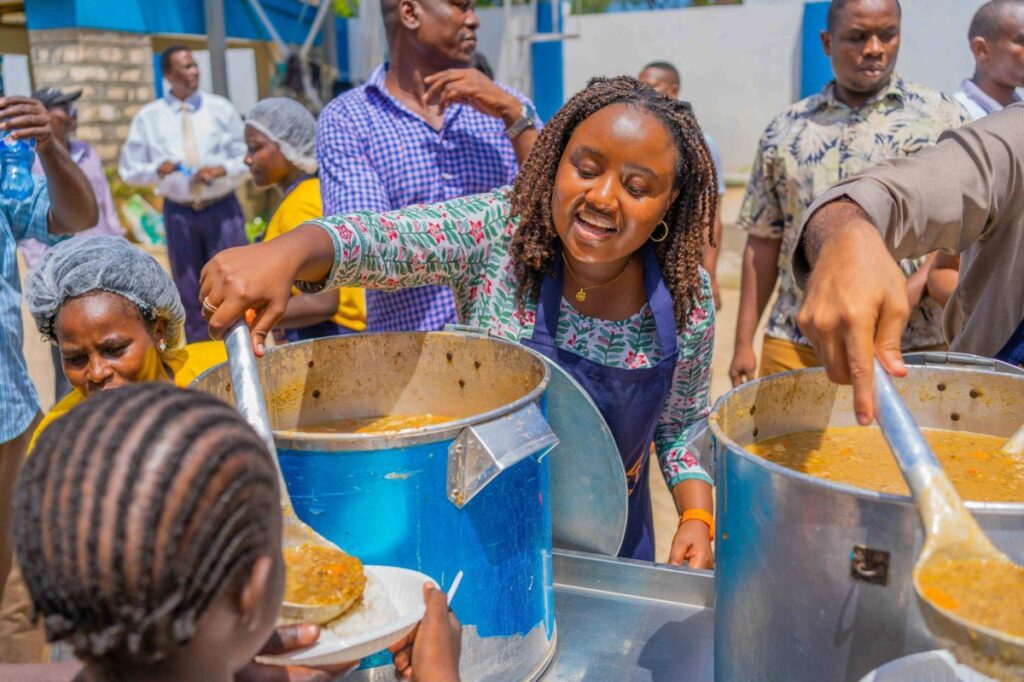
Osaka – Wawira Njiru has never had to look very far to see the devastating effects of chronic hunger. Growing up in Kenya, Njiru witnessed firsthand how malnourishment affected the lives of some of her classmates, particularly when it came to education. Later in life, while studying at university in Australia, Njiru came to realize how much of a role a balanced, nutritious diet had played in her own learning and growth. “One of the key differences between my life and theirs was I could access three meals a day,” she says. That basic connection — that a proper education starts with a proper meal — inspired Njiru to launch Food4Education, a Nairobi-based organization that now feeds nearly half a million Kenyan children every day. And while Food4Education is very much an African solution to a hunger crisis that has only worsened in the face of climate change and conflict, the organization has also drawn inspiration from Japan’s school lunch programs, highlighting how the country’s recovery from the devastation of World War II can serve as a model for developing countries striving to follow a similar path. Worsening hunger Due to factors ranging from the COVID-19 pandemic to the war in Ukraine and the crisis in the Middle East, the 2020s have been marked by a setback in the global fight against hunger. A report by five United Nations agencies released last July showed that 1 in 11 people worldwide faced hunger in 2023, including 1 in 5 in Africa. The global figure is equivalent to about 733 million people, or roughly 152 million more than in 2019. Developing countries are also receiving less aid from wealthier nations, with the U.N.’s World Food Programme slashing the number of people it feeds due to insufficient support from top economies. Last year, the U.N. raised just 46% of the $49.6 billion it had sought for humanitarian aid. Add in the need to adapt food production for a warmer world, and the task of feeding a global population that’s expected to exceed 10 billion by the end of this century becomes all the more challenging. Despite all that, production of many staple crops actually went up in 2024, with global rice and soybean crops reaching record levels, highlighting the fact that, while the world may have enough food, it’s simply not being distributed to the planet’s poorest and hungriest. Enter grassroots solutions like Food4Education, which Njiru founded in 2012 at the age of 21. Farmers water a field with newly planted corn amid a heat wave in drought-hit Jinan, China, in June of last year. | Reuters When it started, Food4Education fed 25 children a day out of a single kitchen using a model that it still employs today. “(Before we started), I was researching about school feeding programs across the world, and there was a lot of inspiration from countries like India and Japan,” she says. Her research eventually led to the adoption of an Indian-style centralized kitchen model, where food is made at scale in a network of kitchens and distributed to students. The organization designs the menu, prepares the food using 80% local ingredients and delivers it to classrooms across Kenya. Funding comes from three sources: the government, donors and the parents, with payment amounts varying by location and ability. By 2024, the organization was feeding 450,000 a day, including 60,000 from a single “gigakitchen” that its website says is Africa’s largest. Njiru and her team aren’t stopping there, however, and have a goal to feed 1 million children per day by 2027 while also spreading their operations beyond Kenya’s borders to other parts of Africa. By 2030, they hope to feed 2 million more children in two other African nations. In Njiru’s mind, improving the hunger situation in Africa isn’t only a benefit for the continent, but also the wider world. “We have the youngest population in the world,” says Njiru. “They need to be educated, they need to be nourished so that they can participate in a global economy.” Climate concerns Rising temperatures are having myriad effects on global food security, and as is the case with many of the worst consequences of climate change, it’s the developing world that is bearing the brunt of the impact. Natural disasters made more severe by warming are rattling food supply chains by damaging vital transportation infrastructure, while climate change-induced heat waves, drought and flooding are harming food production. Njiru has seen the effect of climate change firsthand, and notes that diets in Kenya are becoming less balanced as certain vegetables become too expensive or unavailable. A farmer uproots a field where he was growing maize that failed because of a drought, in Kilifi county, Kenya, in February 2022. | Reuters “The food basket at home has become less nutritious because of climate change because parents are not able to access the vegetables they once were. They’re more expensive. They’re not accessing protein, which is a big part of what children need to develop,” says Njiru, who last year was given the Elevate Prize, which honors leaders who are driving transformative change. Given the impact hunger has on education, Njiru believes that solving that crisis and climate change go hand in hand. Because Africa’s emissions pale in comparison to top emitters like the U.S. and China, decarbonizing African economies can only go so far in curbing warming. Instead, Njiru argues, Africa’s biggest impact can be in building climate resilience and developing solutions, but that potential can only be reached if young people can focus on their education and not have to worry about where their next meal will come from. “It’s such an important connection, I think, and it also fundamentally lies in that climate change solutions are not a broad stroke across the world,” she says. “They are different in different contexts. And for Africa specifically, there’s a lot of social issues that mean that people are vulnerable to climate change.” Model for change It’s not unusual for tourists