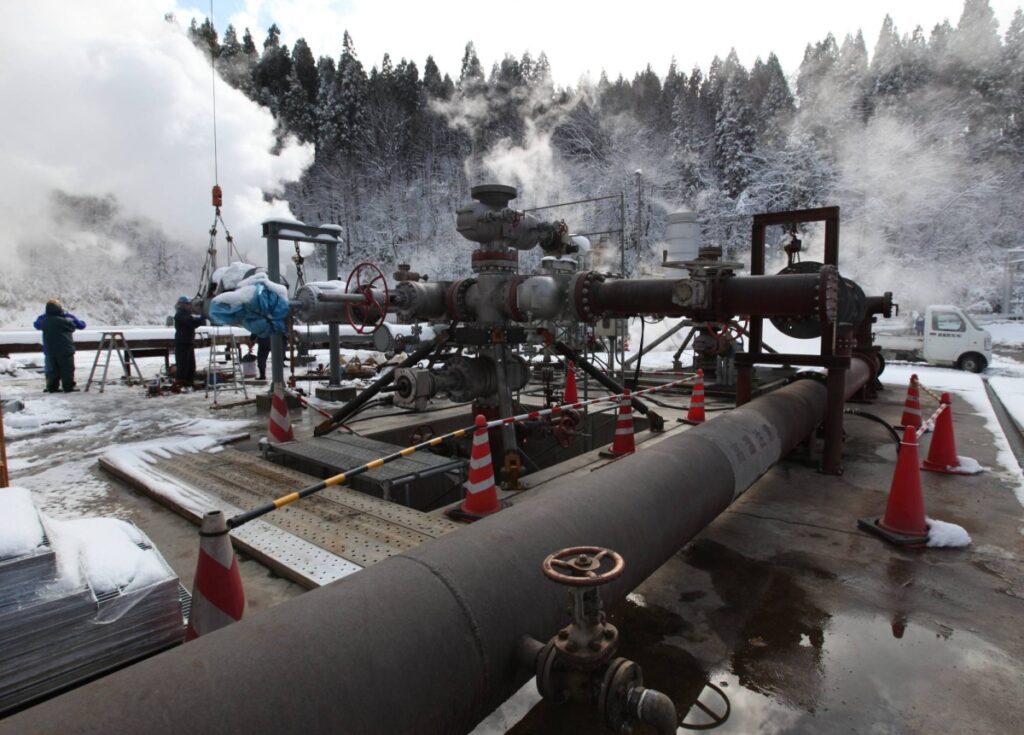
As pressure mounts to decarbonize the power sector amid the threat of climate change, the government has proposed greatly expanding renewables’ share of electricity generation to up to 50% by 2040. Critics have argued that’s not nearly enough for the world’s No. 5 carbon dioxide emitter, but major investments in renewables will still be required even if the target is relatively modest. While the largest sources are expected to be solar (22-29% of total electricity supply), hydro (8-10%) and from on and offshore wind (4-8%), the plan also calls for raising geothermal energy to 1%-2% of total power, a reflection of Prime Minister Shigeru Ishiba’s stated desire to see Japan develop a renewable energy source it has in abundance. Rules regarding drilling for geothermal in national parks, where much of it is located, have presented significant legal and administrative barriers over the years to taking full advantage of this resource, although recent changes have opened the door to further development. Political obstacles remain, starting with individual owners in an industry who worry about the impact geothermal will have on an experience that is almost synonymous with rural tourism in Japan: Hot spring resorts. Big potential Past political debate on renewable energy has usually centered on increasing just two sources: solar and wind, especially offshore wind power. Ishiba’s interest in geothermal is not without merit: Japan sits on some of the world’s most abundant geothermal resources. It boasts the world’s third-largest potential supply of the energy resource, behind only the United States and Indonesia, according to the Japan Organization for Metals and Energy Security (JOGMEC), which is in charge of developing geothermal. The country’s estimated reserves are equivalent to roughly 23 nuclear reactors. Prime Minister Shigeru Ishiba has advocated for geothermal energy since taking office, arguing that it can help Japan reach its climate targets while also revitalizing rural areas. | Jiji The idea of geothermal for electricity generation in Japan is not new: The first geothermal power plant began operation in 1919 in the hot springs resort town of Beppu, Oita Prefecture. But despite its long history and potential, geothermal provided just 0.3% of the overall energy mix in the fiscal year from April 2023, the industry ministry said in a report this month. That compares to 9.8% for solar, 7.6% for hydropower and 1.1% for on and offshore wind. Japan was ranked 10th for geothermal power generation capacity in 2023 by ThinkGeoEnergy, a newsletter for the industry. The U.S. held the top spot, with 3,900 MW (3.9 GW). In a report published earlier this month on geothermal energy’s future, the International Energy Agency said that with technology improvements and project cost reductions, geothermal, currently supplying 1% of global energy demand, could see that share rise to 15% by 2050. A separate IEA report published earlier this year also puts in plain view how the renewable source has struggled to catch on in Japan. The IEA notes that Japan’s total geothermal power plant capacity as of March 2023 was about 500 megawatts (MW) — roughly half the power of one conventional nuclear power plant. That figure is virtually unchanged since 1995, when capacity reached 500 MW for the first time — in fact, capacity actually decreased between 2017 and 2023, unlike every other country the IEA surveyed. The current long-term energy plan for 2030 had called for raising that total to 1.5 GW — about the size of one large nuclear power plant and a miniscule 1% of total electricity supply. But Ishiba sees geothermal energy as a key component of Japan’s push to decarbonize and meet its 2050 carbon neutrality goal, as well as a way to spur regional revitalization, which may have prompted the government to raise the target for 2040 to up to 2%. “Expanding the number of regions that are leading the way in decarbonization through the use of local forest resources and developing geothermal and small- and medium-scale hydropower will bring benefits to local economies,” Ishiba told a meeting of the government’s green transformation (GX) committee on Oct. 31. Political backing Ishiba appears to have a solid base of political support for his effort. Prior to the Oct. 27 election for the 435-seat Lower House, nearly 100 parliamentary members belonged to a group pushing for the use of more geothermal energy, with over half from the ruling Liberal Democratic Party and Komeito. The rest were mostly from the major opposition parties, including Constitutional Democratic Party of Japan, the Democratic Party for the People and Nippon Ishin no Kai. While solar is unlikely to be unseated in the near term as Japan’s top source of renewable energy, lawmakers see big potential for geothermal energy. | Getty Images One of the core members of the group is the LDP’s Goshi Hosono, a former environment minister. “The parliamentary group supporting geothermal is quite broad in terms of its membership and has a lot of political power. Former LDP Secretary-General Toshihiro Nikai (the titular head of the association), did not seek re-election on Oct. 27 and retired from politics, however, so the group has to make a new start,” Hosono said. “But Ishiba has long been a strong supporter of geothermal energy, because it can lead to regional revitalization,” he added, especially since geothermal resources are often located in rural areas of the country. Hurdles remain While the potential for Japan to greatly expand geothermal power is widely recognized, there have traditionally been several barriers standing in the way of tapping this clean energy source. Many of the ideal locations for setting up geothermal plants are located in national or quasi-national park areas — an estimated 80% of the country’s geothermal energy potential falls within these jurisdictions. For decades, strict environmental regulations on drilling inside parks made developing their geothermal resources all but impossible. However, Hosono said that after the March 2011 earthquake and tsunami, which caused a massive meltdown at the Fukushima No. 1 nuclear power plant, calls have grown to make better use of renewable energy,