Mika Ninagawa transforms the Kyocera Museum into a vibrant dreamworld
The 52-year-old is an award-winning photographer with an unmistakable style; a film and TV series director whose works, such as the manga adaptation “Helter Skelter” (2012) and the Netflix original series “Followers” (2020), explore identity and desire with visceral allure; and a music video director who has collaborated with major Japanese acts like AKB48 and international stars such as Alicia Keys.
Her photos captivate with lush palettes and dreamlike nature motifs balancing the flowery and the dark, often juxtaposing the ephemeral and the eternal in her art, now brought to its most expansive scale in the exhibition “Ninagawa Mika with EiM: Lights of the beyond, Shadows of this world” at the Kyoto City Kyocera Museum of Art, Higashiyama Cube.
The museum, close to the Higashiyama mountains, is a majestic setting, and Ninagawa’s evocative compositions have enveloped Kyocera’s partially transparent Higashiyama Cube, making use of the space’s interplay of light and openness. Ninagawa notes that Kyoto, a city where architecture whispers the passage of time, had a strong influence on her work.
“Life and death are so embedded here. If you walk around town, you find so many places where you see this,” she tells The Japan Times on the exhibition’s opening day. “Suddenly you encounter a spot that opens up to the beyond, even if it’s just an illusion you have,” she adds, referring to how she got the idea for the exhibition’s title.
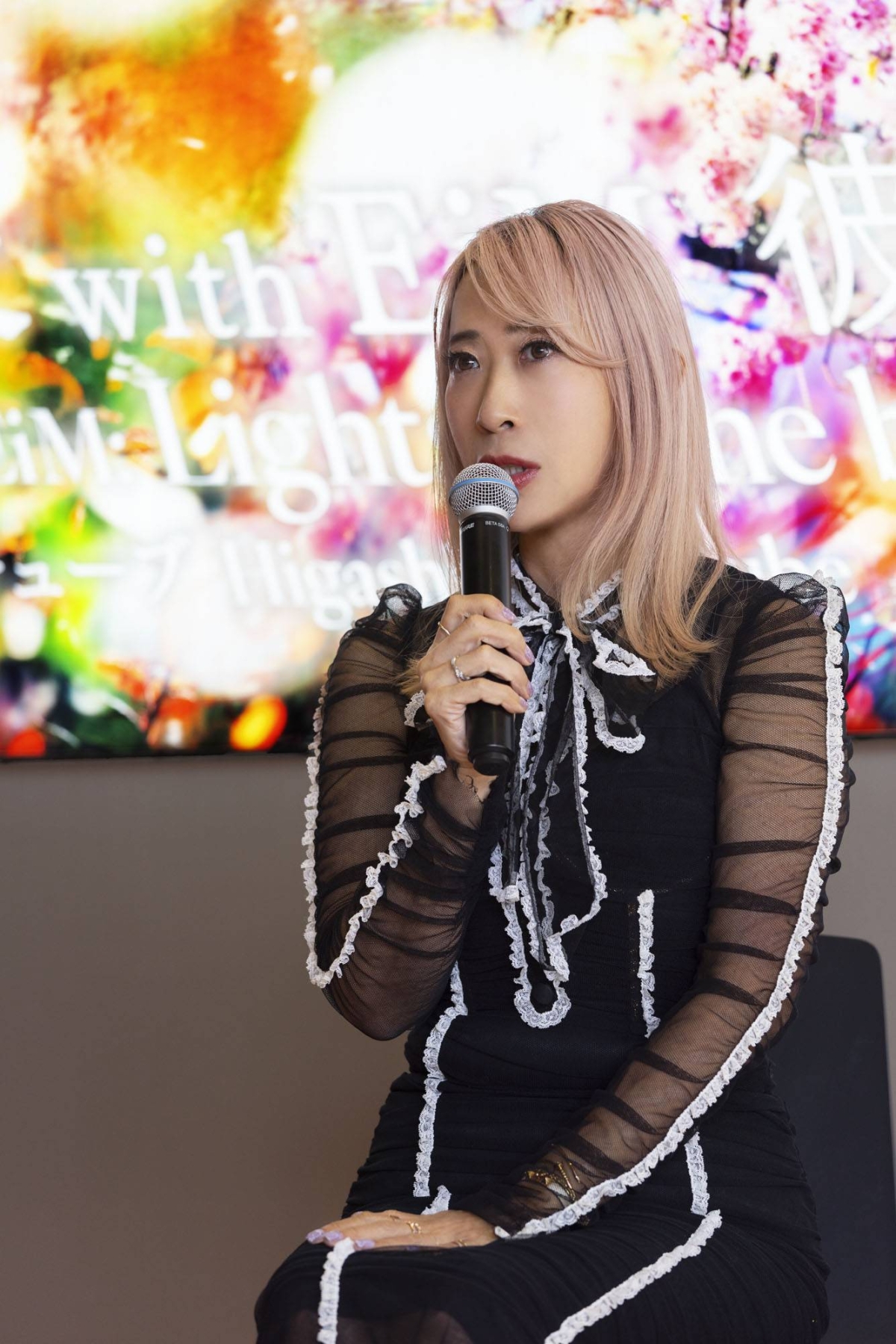
Mika Ninagawa says that she carries artistic influence from her late father, theater director Yukio Ninagawa.
| © Mika Ninagawa, Courtesy of Tomio Koyama Gallery
Collaborating with her collective EiM (standing for “eternity in a moment”) — an ensemble of creatives that includes data scientist Hiroaki Miyata, set designer Enzo, creative director Isao Kuwana and lighting director Koshiro Ueno — Ninagawa has crafted an experience that straddles the boundaries of photography, film and installation art. “When we exchange ideas, new things arise, and also I’m quite enjoying what comes out of the team creation,” she says.
The exhibition is structured as a journey through 10 interconnected spaces that draw the viewer into a surreal visual narrative. Ninagawa’s photographic works, taken from everyday life without the aid of computer graphics, are layered with elements of artifice like cascading crystal garlands, luminous displays and artificial flora. “The world is still very interesting as is,” Ninagawa says, explaining her dedication to unaltered imagery, although she employs a degree of theatrics in the exhibition, influenced by her late father, theater director Yukio Ninagawa.
“I was born into a family of theater; my father was a theater director, so I grew up surrounded by performances. In that sense, the world of fiction was always close to me,” she says, adding that acting isn’t entirely fake, as it involves real emotions. And while her photography portrays reality without manipulation, the dialogue with fiction remains present in her mind as she takes her shots.
The corridor leading to the exhibition offers an initial glimpse of the city outside, grounding visitors in the reality they are about to leave behind. The transition begins in earnest with “Flowers of the Beyond,” a space drenched in a burning red hue and flashes of black, with more than 4,000 synthetic red spider lilies.
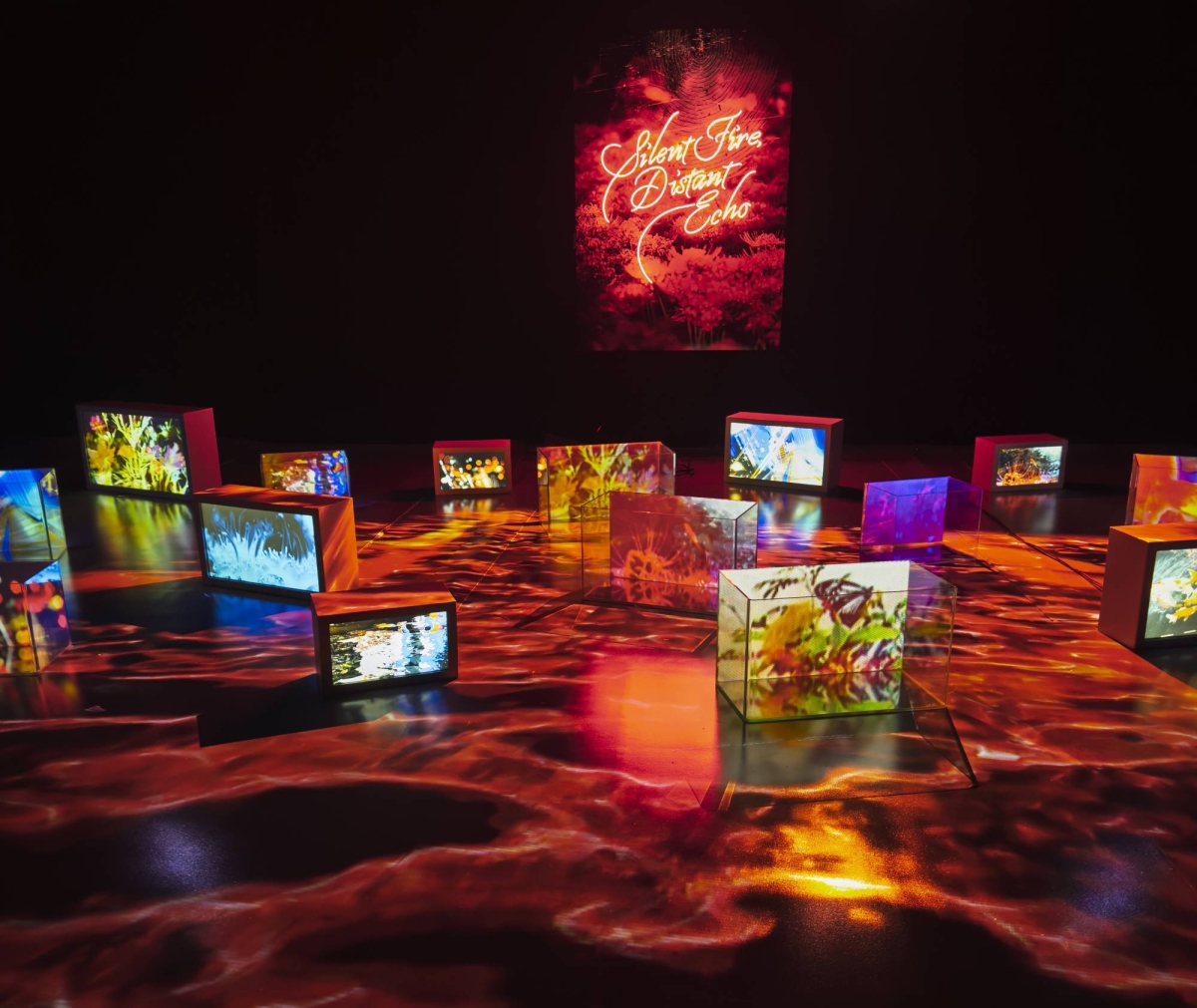
Ninagawa’s photographic works, taken without the aid of computer graphics, are layered with elements of artifice like cascading crystal garlands, luminous displays and artificial flora.
| © Mika Ninagawa, Courtesy of Tomio Koyama Gallery
“This flower references death in Japan,” Ninagawa notes, hinting at the cultural weight imbued. The flowers guide visitors through the liminal space between existence and oblivion, symbolizing life’s fragility and proximity to the transcendent.
Further into the museum’s path of luminescence and obscurity, “Whispers of Light, Dreams of Color” transforms a large hall into a shimmering cascade of over 1,500 strands of crystal garlands, fracturing light into myriad colors, their gentle swaying evoking natural phenomena with perhaps an otherworldly tinge. Ninagawa’s attention to sensory detail is key here. “The base concept is capturing sunlight,” she says. “But the experience shifts depending on where you are in the room. With natural light, the effect is one way, and with controlled light, it transforms into another.”
The exhibition crescendos with “Dreams of the Beyond in the Abyss,” a dual-space installation that juxtaposes flourishing artificial blooms with hellish landscapes, creating a psychedelic effect. “(The flowers) function as an entrance to the other world, and also as a gradation,” the artist says. “Step by step, letting us go back to reality.” These transitions evoke despair and renewal, themes that resonate deeply in Ninagawa’s oeuvre.
Each installation in the exhibition invites viewers to immerse themselves in an emotional and sensory dialogue. Whether standing amid the shimmering garlands or navigating the vivid intensity of red-drenched flowers, this conceptual layering turns the exhibition into an encounter with the spaces between reality and imagination.
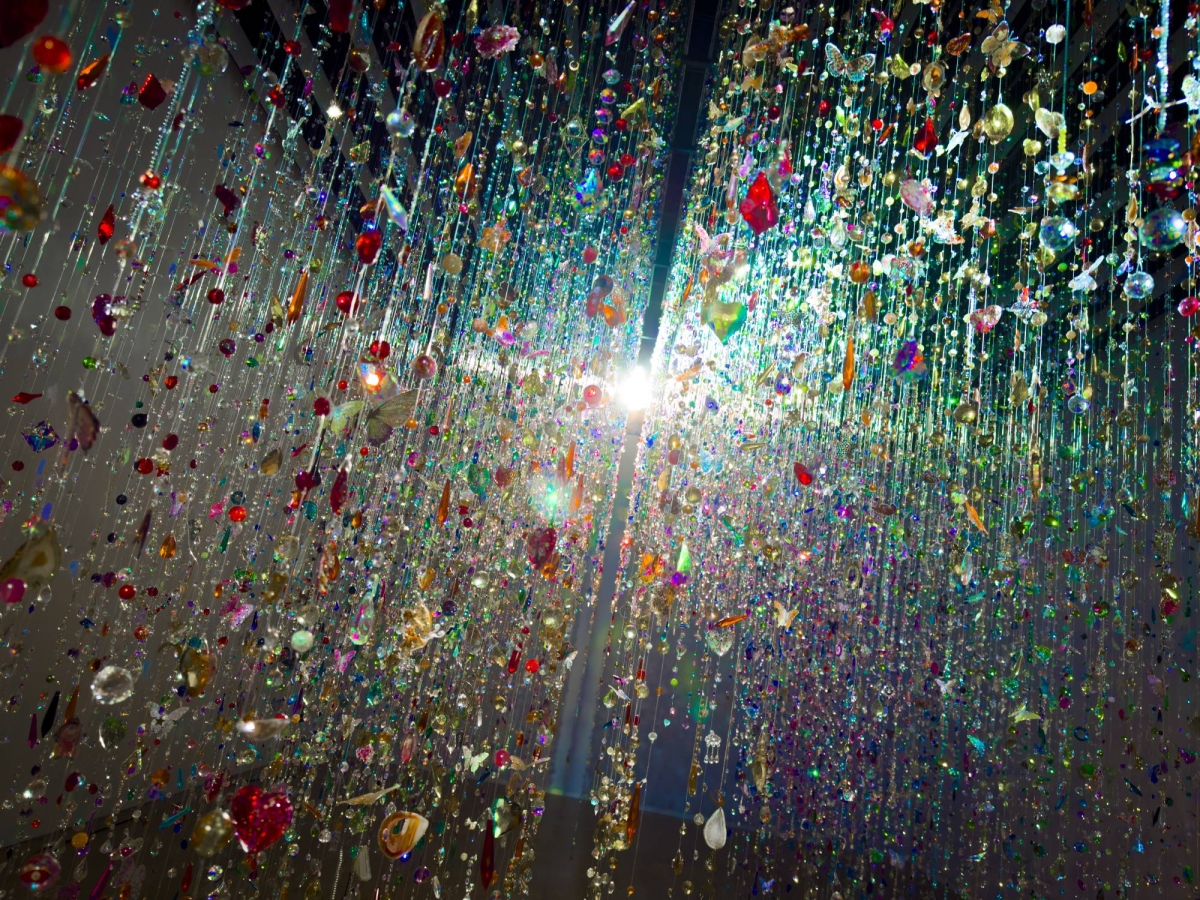
“Whispers of Light, Dreams of Color” transforms a large hall into a shimmering cascade of over 1,500 strands of crystal garlands, fracturing light into myriad colors.
| © Mika Ninagawa, Courtesy of Tomio Koyama Gallery
Interspersed throughout these installations are rooms with digital screens displaying Ninagawa’s photos and videos in hypnotic collages. A couple of the rooms adopt a film theater layout, and toward the end of the exhibition’s route is a room covered entirely by screens — the floors, walls and ceiling — where you become completely immersed in rapid successions of Ninagawa’s images of nature. It’s an arresting, almost disorienting experience.
And perhaps it’s these spaces that make the strongest emotional and sensory impression, since they display the core beauty of Ninagawa’s photography and filmmaking that inspire the rest of the exhibition’s sculptural installations. But each element of the exhibition, from the photographic works to the structural and spatial designs, is imbued with a sense of searching — inviting us into a world where the lines blur, revealing not an answer but an experience to be carried forward.
Regarding what she hopes visitors take away from “Lights of the beyond, shadows of this world,” Ninagawa says, “More than a journey toward the beyond, I hope it’s an internal journey.” This intention is reflected in the exhibition’s thoughtful design, which begins and ends in the same place — the glass corridor adorned with transparent prints of her photographs of flowers.
“You see the same scenery, but perhaps a bit brighter. You encounter yourself again, but maybe in a deeper way,” she adds. This cyclical structure mirrors the introspection Ninagawa hopes visitors will carry beyond the exhibition, as they step back into the external world they left behind, but with an altered perception.